Jordan with Kids: The Trip Changes When the Smallest Traveler Sets the Pace
Updated: August 2026
Jordan has many of the ingredients that make family travel memorable: places children recognize before they arrive, landscapes that feel genuinely different from home, ruins they can walk through rather than observe behind glass, desert experiences that require very little historical enthusiasm to enjoy, and enough variety that the journey does not need to become a succession of museums.
None of that automatically makes a Jordan itinerary family-friendly.
The mistake parents often make is designing the trip they would choose as adults and then trying to make it suitable for children by shortening a few visits, adding snack breaks and booking hotels with swimming pools. Sometimes that works, but family travel usually needs a more fundamental adjustment.
A six-year-old does not experience a four-hour transfer as simply four hours of transportation. A teenager who enjoyed the first archaeological site may be considerably less enthusiastic about the third one in two days. A hotel swimming pool has little family value when everybody returns after it closes, while an impressive desert camp can become surprisingly inconvenient if reaching the bathroom at night requires getting dressed and walking outside with a sleepy child.
The destinations have not changed.
The practical meaning of them has.
A successful family journey through Jordan therefore begins with a different question from the one adults traveling alone might ask. Instead of wondering how many major places can fit into the available days, parents should ask:
How much Jordan can our family genuinely enjoy before the trip begins feeling like work?
That answer produces a much better itinerary.
Children's Ages Matter More Than the Label “Family Tour”
There is no single family travel style because a couple traveling with a four-year-old has very different needs from parents bringing two teenagers.
Younger children usually make routine, meals, toilet access, walking distance and sleep more influential. The archaeological importance of a destination means relatively little when somebody is tired, hungry or has decided that walking another kilometer is a personal injustice.
School-age children often provide an interesting middle ground. They can walk farther, understand historical stories and become surprisingly engaged when guides connect ruins with people rather than dates, yet several long sightseeing days in succession can still exhaust their enthusiasm.
Teenagers create another dynamic altogether.
They may handle the physical itinerary easily while wanting more independence, less continuous explanation and experiences that feel active rather than educational. Wadi Rum can suddenly become more successful than another historical site, while free time in Amman may be valued more than parents expected.
Before choosing the route, think about the children you actually have rather than the generic “family” imagined by a travel brochure.
Petra Is Not Too Much for Children; The Wrong Petra Plan Can Be
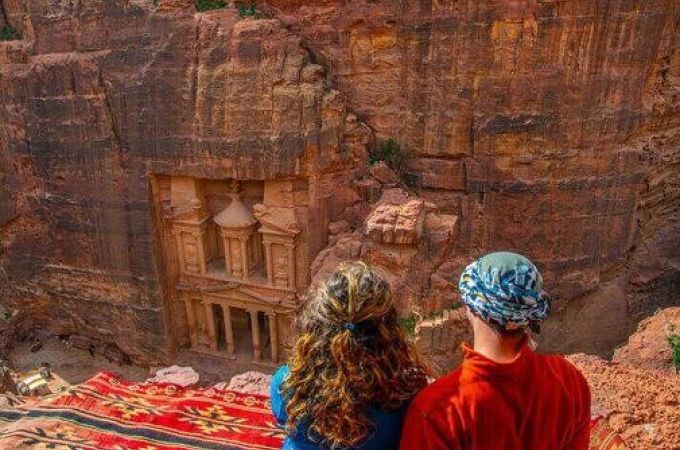
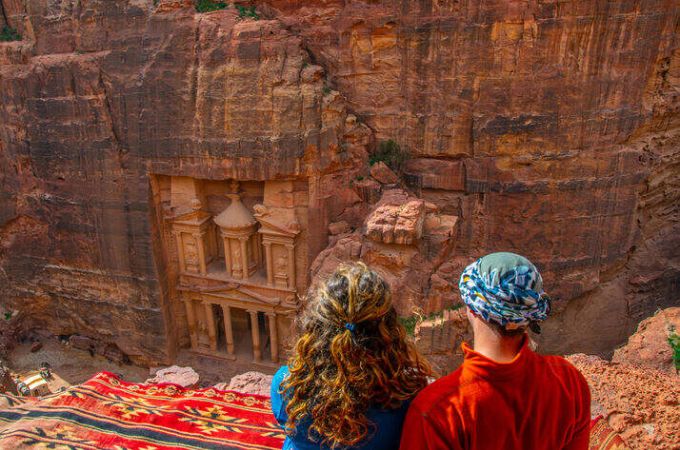
Petra often creates the greatest anxiety before a family trip because parents know that visiting involves walking and that the archaeological area extends far beyond the Treasury.
The useful question is not whether children “can do Petra.”
Children vary too much for that.
Think instead about how your family normally handles walking, heat, stairs and long outdoor days. A child who happily spends hours hiking at home may approach Petra very differently from one who becomes tired after an hour of city sightseeing.
The day should therefore have priorities rather than an obligation to complete a predetermined route.
Allow enough time for the approach through the Siq, because rushing children through it merely to reach the Treasury removes much of the anticipation that makes the experience memorable. Once inside the wider archaeological area, decide how far the family continues according to energy rather than pride.
This becomes especially important with ambitious extensions involving significant climbing.
An adult may continue because “we came all this way.” Children rarely find that argument persuasive.
A better family rule is to finish while Petra is still one of the best things they have done in Jordan, rather than continuing until everybody associates the final hour with exhaustion.
Do Not Put the Two Hardest Days Beside Each Other
Adults often recover from a demanding sightseeing day by sleeping well and starting again the following morning.
Children may technically recover while becoming progressively less interested.
This distinction matters when sequencing Jordan.
If Petra is going to involve substantial walking, the following day should ideally change the type of experience rather than immediately demanding another long archaeological visit. Wadi Rum can work beautifully in this respect because the environment changes completely and much of the experience does not depend on children walking continuously while listening to explanations.
The same principle works elsewhere.
A long driving day followed by an extremely early start can be harder than either day independently. Several archaeological visits in succession may be educationally impressive while gradually producing diminishing enthusiasm.
Alternate demands whenever the route allows it.
Walking can be followed by desert scenery. History can be followed by swimming. A highly structured guided day can be followed by something looser.
Family pacing is not simply about doing less.
It is about asking children to do different things before they become tired of doing the same thing.
One Major Experience Can Be Enough for an Excellent Family Day
Adults planning expensive international travel can develop a strange fear of empty afternoons.
If the family finishes the main sightseeing at three o'clock, there is a temptation to search for something else nearby because several usable hours remain.
Those hours may already have a purpose.
Children might want the hotel pool, a snack, time without adults explaining the historical significance of anything, or simply an opportunity to play with whatever they brought from home.
Teenagers may want Wi-Fi and privacy for an hour.
Parents may discover they appreciate the same break.
Building the day around one substantial experience does not mean every family afternoon should be empty, but it removes the pressure to make each hour justify the cost of the holiday.
Some of the easiest family memories happen after the formal itinerary has finished.
Protect enough room for them to occur.
Wadi Rum Accommodation Should Be Chosen at Bedtime, Not at Sunset
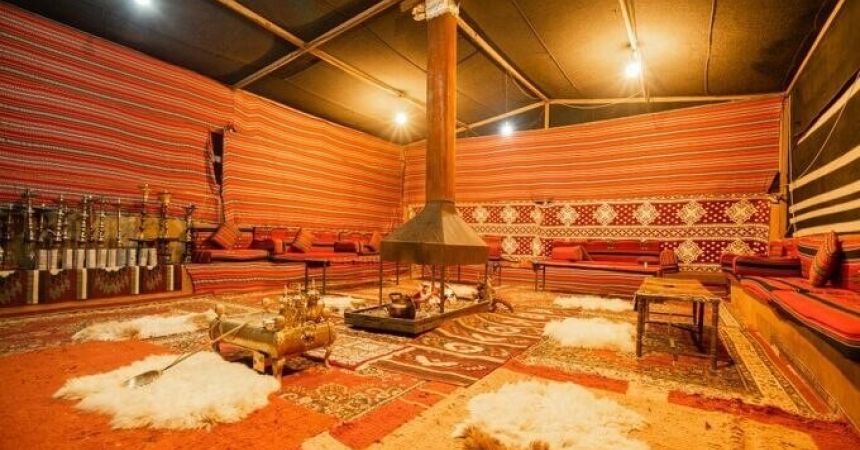
Photographs of Wadi Rum accommodation understandably emphasize the dramatic parts: desert views, transparent sections of rooms, sunsets, stars and unusual architecture.
Parents should temporarily ignore all of that and imagine 2:17 in the morning.
A child wakes and needs the bathroom.
How does that work?
Is the bathroom private? Is it attached to the room or elsewhere? What is the sleeping arrangement? Will everybody fit comfortably? What are nighttime temperatures likely to feel like during your travel period? How much luggage needs to accompany you into the camp?
These questions are considerably less photogenic than sunset, but they can determine whether parents remember the overnight as magical or exhausting.
Families with teenagers may happily prioritize atmosphere and distinctive accommodation. Parents with younger children may value bathroom access and sleeping arrangements far more highly.
Neither choice is more authentic.
The right desert camp is the one that still works after everybody stops looking at the view.
Wadi Rum Often Wins Over Children Without Trying Very Hard
Historical destinations sometimes need interpretation before children understand why adults are impressed.
Wadi Rum has an advantage: the landscape does much of the work.
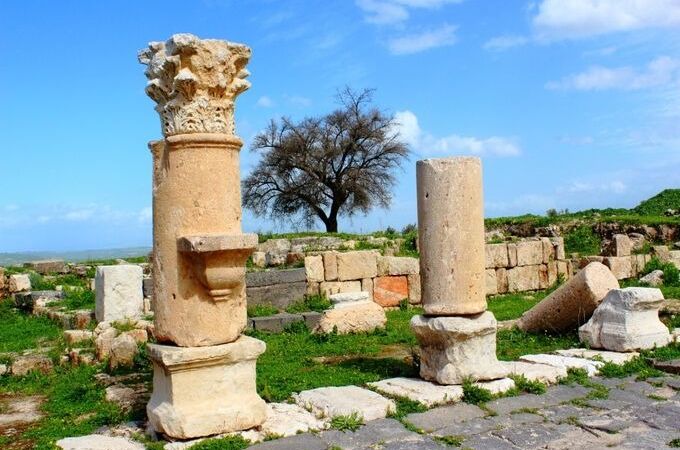
The scale, rock formations, desert transportation and unfamiliar surroundings can make the experience immediately engaging without requiring a child to understand Nabataean trade routes or Roman urban planning first.
That makes the desert especially useful within a family itinerary.
It can reset children who have already experienced several culture-heavy days while allowing parents to continue exploring Jordan rather than scheduling an artificial “kids' day.”
Families considering professionally arranged Jordan Family Tours should look at how much genuine desert time is included rather than simply checking whether Wadi Rum appears in the itinerary.
There is a difference between experiencing the desert and stopping there long enough to say you visited.
A Swimming Pool Has No Value While You Are Still Sightseeing
Parents frequently prioritize hotels with pools when planning family holidays, which makes complete sense until the daily itinerary is considered.
If breakfast is followed by an early departure and the family returns near dinner after a full day of touring, the pool may be little more than a photograph on the booking page.
Look at hotel facilities together with the hours you will realistically spend at the property.
On a free afternoon, the pool may be worth paying more for because it becomes part of the family experience. During a one-night transit stay, practical room configuration and location may matter considerably more.
This is particularly relevant when comparing hotel categories.
A higher-category property is not automatically more family-friendly. Sometimes the better family hotel is the one that removes twenty minutes from tomorrow's transfer, provides the room arrangement you actually need and allows everyone to eat without another journey.
Children rarely remember how many stars were beside the hotel's name.
Parents remember whether bedtime was easy.
Family Rooms Are Not the Same Everywhere
This is one detail worth resolving before confirmation rather than discovering at check-in.
“Family room” can describe very different arrangements depending on the property. It may mean one larger room, interconnected rooms, adjacent rooms, a suite with separate areas or a standard room configured with additional beds.
Those differences become important when children are different ages.
Parents traveling with small children may strongly prefer direct internal access between sleeping areas. Families with teenagers might appreciate greater privacy, while a family of five may discover that occupancy limits require two rooms regardless of how large one room appears.
Do not rely solely on the room category name.
Ask what the actual sleeping arrangement is, how many proper beds are provided, whether additional beds are rollaways or sofa beds and whether connecting rooms are guaranteed or merely requested.
These questions are not glamorous.
Neither is discovering at 10:30 PM that the sleeping arrangement you imagined is not the one you booked.
Four Hours in a Vehicle Means Something Different With Children
Jordan's geography allows many major destinations to be connected overland, but road journeys need to be evaluated from a child's perspective.
Parents should think beyond driving time.
Where can you stop comfortably? Does anyone experience motion sickness? Will lunch occur at approximately the time children normally eat, or has it been scheduled according to when the sightseeing ends? Is there enough water in the vehicle? Does the youngest child usually sleep during long drives, and if so, will arriving at the hotel after an afternoon nap destroy bedtime?
These considerations can influence route design.
Sometimes an interesting sightseeing stop breaks a journey perfectly because everybody gets out, moves around and resets. On another day, adding an attraction merely makes an already long transfer longer.
Private transportation can become especially valuable for families because toilet breaks and unexpected stops do not need to conform to a group timetable.
The benefit is not necessarily luxury.
It is control.
Early Starts Should Be Spent Carefully
Some days genuinely benefit from beginning early.
Cooler temperatures, site conditions, transportation schedules or the desire to reach a major attraction before the day becomes busier can all justify setting an alarm.
The problem begins when every day becomes an early day.
Children who tolerate one 06:30 departure enthusiastically may react very differently to the fourth one.
When reviewing a family itinerary, count consecutive early starts rather than examining each day individually. If several occur together, look for one morning that can begin later without sacrificing something important.
This is particularly valuable after a desert overnight or physically active day.
Families do not need to maintain their home routine perfectly while traveling, but repeated sleep disruption eventually appears somewhere else, often at exactly the moment parents hoped everyone would enjoy a major attraction.
The Dead Sea Requires Parents to Be More Attentive Than the Photographs Suggest
Children may find the sensation of floating in the Dead Sea fascinating, but this is not an ordinary swimming environment.
Parents should follow the current safety guidance provided locally and by the property being used, supervise children closely and make sure they understand that splashing, diving and putting the face into the water are not normal Dead Sea activities.
Cuts or irritated skin can also make contact with the highly saline water uncomfortable.
Practical access to fresh water for rinsing afterward matters, which is one reason the facilities available through the chosen hotel, resort or arranged access should form part of family planning.
Some younger children may decide almost immediately that they dislike the sensation.
That is fine.
The family does not need to remain in the water long enough to satisfy an imaginary minimum Dead Sea experience.
Sometimes five memorable minutes produce a better story than forty uncomfortable ones.
Aqaba Can Solve a Family Pacing Problem Without Being a Children's Attraction
Aqaba does not need to be added because somebody declared that families require beach time.
It becomes useful when the family actually enjoys swimming, snorkeling, diving or resort environments and the wider itinerary has already contained several active cultural days.
In that situation, a coastal stay can change the rhythm dramatically.
Children can spend part of the day doing something immediately understandable, parents can reduce the amount of organized sightseeing, and everybody can remain in the same hotel for more than one night.
For families uninterested in marine activities, Aqaba may add little beyond another geographical transition.
This is an important distinction because “family-friendly” should never become a synonym for “add a beach.”
The correct family itinerary reflects what your children enjoy, not what other people's children supposedly enjoy.
Teenagers Should Be Given Some Ownership Before the Trip Begins
Teenagers are often treated as passengers in family holiday planning and then criticized when they appear insufficiently enthusiastic about the itinerary chosen entirely by adults.
Give them something to own.
That could mean selecting one restaurant in Amman, deciding between two optional activities, choosing a particular Wadi Rum experience, researching what interests them about Petra or taking responsibility for photographs during part of the journey.
The decision does not need to control the entire holiday.
It simply creates investment.
Older teenagers may also appreciate independent time where circumstances make it appropriate, particularly at hotels or in environments where parents are comfortable allowing some separation.
A family trip does not require every person to experience every hour together.
Occasional independence can make the shared portions better.
Younger Children Need Stories More Than Chronology
Adults interested in history can happily listen to explanations involving dynasties, trade networks, architectural periods and political changes.
Young children usually need another entry point.
Who lived here?
How did they get water?
Where did people sleep?
Why was this built inside rock?
How did travelers cross the desert?
What happened if somebody wanted to enter the city?
Good family guiding recognizes when historical accuracy needs to be communicated through narrative rather than reduced to a sequence of dates.
Parents can help by introducing a few places before departure through photographs, maps or age-appropriate stories. Recognition creates excitement: the Treasury means more when the child has been waiting to see whether it really looks like the picture.
The goal is not turning the holiday into school.
Jordan is much more interesting when children are allowed to become curious before adults begin testing what they learned.
Picky Eating Does Not Need to Become the Main Family Travel Problem
Food anxiety can make parents overplan meals before they know what their children will actually eat.
A more practical approach is to identify reliable fallback foods while leaving enough room for experimentation.
Jordanian meals can include breads, rice, grilled dishes, dips, vegetables and other relatively approachable components alongside foods that may be unfamiliar. Some children will immediately experiment; others may survive happily by constructing very simple plates from several familiar elements.
Breakfast can be particularly useful because hotel buffets often provide enough variety to start the day without negotiation.
Carry a few familiar snacks during long sightseeing or driving days, not because children should avoid local food, but because hunger is an unnecessarily difficult moment to begin cultural education.
Parents with allergies or strict dietary requirements should communicate them precisely in advance.
“Picky” and “medically unable to eat” are completely different planning issues.
Private Transportation Changes Family Travel More Than the Vehicle
Parents sometimes compare private and shared touring primarily through comfort and price.
With children, flexibility may matter more.
A private arrangement can allow the family to stop unexpectedly, leave later when appropriate, shorten a visit that has clearly stopped working or spend longer somewhere the children unexpectedly love.
That final possibility deserves emphasis.
Family flexibility is not only about managing problems.
A child may become fascinated by something the adults expected to visit quickly. A desert stop may work far better than anticipated. Lunch may become one of the day's highlights because everybody is relaxed and talking.
A rigid schedule can force the family away from successful moments as efficiently as it forces them through unsuccessful ones.
For families who value that control, Private Jordan Family Holidays can be more relevant than simply choosing a higher hotel category.
Time flexibility is often the upgrade parents notice most.


A travel professional specializing in tailor-made travel planning, guest experience management, and multi-destination tourism operations.
With over 23 years of experience in the travel industry, he designs and manages private and cultural tours for international travelers across Türkiye, Greece, Egypt, Jordan, Morocco, and other destinations.
He has strong expertise in both online and face-to-face guest communication, sales processes, and end-to-end travel operations.
Working closely with hotels, travel agencies, and local partners, he ensures smooth coordination and high-quality travel experiences at every stage of the journey.
His focus is on delivering personalized, reliable, and seamless travel experiences for international guests worldwide.